
Constitution Day: Why 7th January Must Always Matter
Posted on January 7, 2026 Leave a Comment
Every nation that takes its Constitution seriously must, from time to time, pause to reflect on it, not merely as a legal document, but as a living framework that confers power, protects liberty, and binds a people together. In Ghana, 7thJanuary is such a moment. Constitution Day is not simply another statutory public holiday; it is a deliberate affirmation that our democracy is anchored in law, restraint, and institutional continuity.
The 1992 Constitution came into force on 7th January 1993, marking Ghana’s return to constitutional rule after years of political instability and authoritarianism. It ushered in the Fourth Republic, restoring civilian governance, entrenching fundamental rights, and establishing a carefully calibrated system of checks and balances. Yet, for many years, this foundational moment passed annually without formal national recognition. We witnessed the celebration of Independence Day, Workers’ Day, and Republic Day. Curiously, however, the Constitution, the supreme law under which all authority is exercised, had no dedicated place in our civic calendar.
That omission was neither accidental nor trivial. Constitutionalism thrives on memory. When societies fail to ritualise their constitutional moments, they risk reducing the Constitution to a purely technical instrument, invoked only in courtrooms or moments of crisis. Recognising Constitution Day through statute was therefore an intentional act of governance: a reminder that constitutional rule is not self-executing, and that democracy must be nurtured through both law and culture.
It was against this background that the Public Holidays Act was amended to formally establish Constitution Day as a statutory public holiday. The Explanatory Memorandum accompanying the Public Holidays (Amendment) Bill captured the rationale with clarity and conviction as follows:
“The 1992 Constitution established the Fourth Republic, which was inaugurated on 7th January, 1993. The Fourth Republic has provided the basis for the longest, uninterrupted period of stable, constitutional rule in the history of Ghana. It has witnessed seven successive presidential and parliamentary elections and the assumption of office of five Presidents, four of whom are still alive. The transfer of power between the two major political parties, on three occasions in the Fourth Republic, has been peaceful, without the unfortunate incidents of violence and war that have characterised the history of some of our neighbouring countries. During this period, there have been landmark cases that have shaped the constitutional jurisprudence and entrenched the fundamental human rights of the people of Ghana, including freedom of speech. It is therefore worth setting aside the 7th day of January as a national holiday to acknowledge our collective efforts, as a country, in ensuring that the tenets of democracy, the rule of law and the principles of constitutionalism are upheld.”
In my capacity as Legal Counsel to the President, I was privileged to participate in the legal and policy processes that led to this reform. The objective was clear: to embed constitutional reflection into the national consciousness and to signal that fidelity to the Constitution transcends administrations, ideologies, and political cycles. By placing Constitution Day firmly on the statute books, Parliament affirmed a simple but profound truth, to wit, constitutional governance is neither optional nor partisan.
For that reason, it is appropriate to commend the current Mahama administration for retaining Constitution Day as part of Ghana’s statutory holiday framework. Constitutional continuity is itself a democratic virtue. When successive governments preserve institutions established by their predecessors, particularly those tied to constitutional values, they reinforce public confidence in the stability and neutrality of the State. Constitution Day belongs to the Republic, not to any one government.
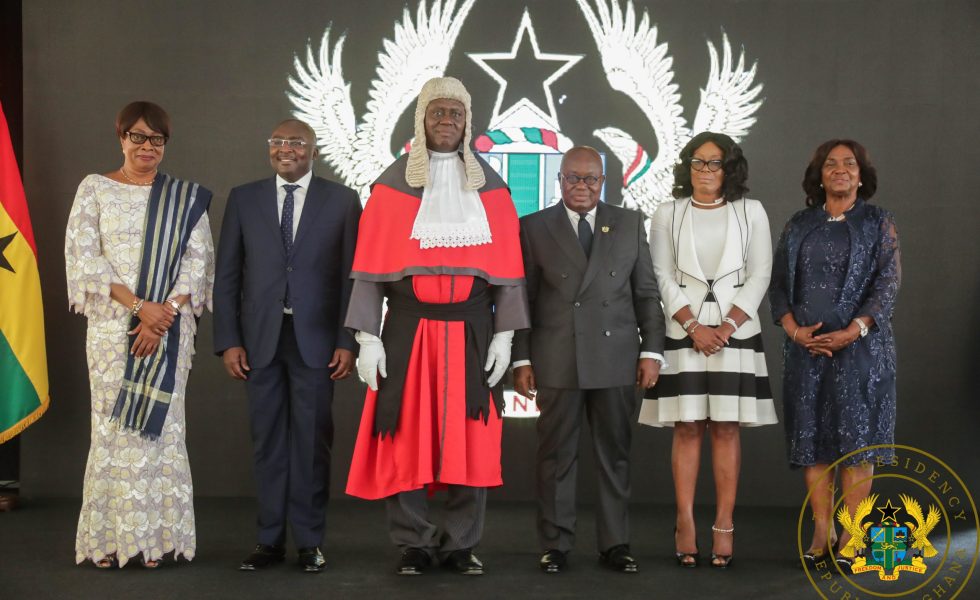
The symbolic power of Constitution Day was vividly demonstrated on its very first observance. On that day, Ghana witnessed the swearing-in of the 14th Chief Justice of the Republic, Justice Anin Yeboah, a Justice of the Supreme Court, an act that sits at the very heart of our constitutional architecture. Judicial investiture is more than just another ceremony; it is a constitutional affirmation of the rule of law and the independence of the Judiciary. That this moment occurred on Constitution Day was neither coincidental nor insignificant. It visually and institutionally reinforced the fundamental role of the Judiciary as the custodian of the Constitution and the sole authority constitutionally empowered to interpret and enforce its supremacy.
I was entrusted with coordinating the investiture, working closely with the President and other key stakeholders involved in organising the ceremony. It demanded exacting constitutional fidelity, strict adherence to procedure, precision in protocol, and a keen appreciation of symbolism. The President’s public commendation of how the ceremony was conducted was not a personal accolade; it was an institutional endorsement of constitutional order, of getting the small things right because they safeguard the big principles. In constitutional democracies, process matters. Ceremony matters. Details matter.
In his address on that occasion, President Akufo-Addo aptly observed:
“Appropriately, we are doing so [swearing in Justice Anin Yeboah] on Constitution Day – a day chosen to celebrate as a public holiday to commemorate the virtues of constitutionalism which has enabled us in the Fourth Republic to enjoy the benefits of the most prolonged period of stable constitutional governance in our country’s history.”
On the second observance of Constitution Day, 7th January 2021, the constitutional symbolism of the day was further completed. On that occasion, the Speaker and Members of Parliament were sworn into office, formally constituting the Legislature, while the President of the Republic and the Vice President were sworn into office, embodying the Executive arm of government. These ceremonies were far more than ceremonial. They represented the full activation of Ghana’s constitutional architecture under the Fourth Republic. Significantly, the Speaker, the President, and the Vice President each took their respective oaths before Chief Justice Anin Yeboah, who himself had been sworn into office on the first Constitution Day. In that sequence lay a powerful constitutional narrative: a Judiciary inaugurated on Constitution Day administering the oaths that brought the Executive and Legislature into being, thereby completing the institutional symmetry and reinforcing the supremacy of the Constitution over all three arms of State.
As we commemorate Constitution Day today, the lesson is not nostalgia, but responsibility. Our Constitution is a living instrument, tested daily by governance choices: how power is exercised, how public funds are managed, how appointments are made, how rights are respected, and how institutions are allowed to function independently. Constitution Day should therefore provoke honest national reflection: are we strengthening constitutional culture, merely reciting constitutional text, or sacrificing it on the altar of political expediency?
Our reflection must go beyond ceremony and symbolism to the more difficult question of how constitutional power and discretion are being exercised in practice. The Constitution is not threatened only by coups or open defiance; it is more subtly eroded when its safeguards are bent, ignored, or applied selectively in the pursuit of short-term political ends.
When the independence of the Judiciary, expressly guaranteed by the Constitution, is undermined through the removal of a Chief Justice on grounds that struggle to meet the constitutional threshold; when the report that formed the basis of such removal is withheld from the public despite clear legal obligations requiring its disclosure; when citizens are arrested and publicly treated as guilty before they are charged, in direct violation of the presumption of innocence; when accused persons are subjected to oppressive bail conditions beyond their means and left on remand for days before trial, with the courts seemingly unable to intervene; these are not isolated procedural concerns. They are constitutional red flags.
Equally troubling is the manner in which prosecutorial power is exercised. When the Attorney-General discontinues cases involving political allies and seeks to justify those decisions through press conferences rather than through the courts; when the same Attorney-General appears to “try and convict” his political opponents in the media who are yet to appear before a judge, only to adopt a different posture in court; when reputations are publicly damaged while the constitutional guarantee of innocence until proven guilty is ignored; then the integrity of the criminal justice system itself is called into question.
A functioning constitutional democracy also depends on vigilant intermediaries. When sections of the media and civil society, entrusted with the duty to hold power accountable, drift into uncritical praise-singing, public oversight weakens. When state institutions treat the constitutional and statutory right to information with contempt, refusing disclosure without lawful justification, transparency suffers, and accountability recedes. These failures, taken together, should give us pause.
Constitution Day must therefore be a moment of collective introspection. The Constitution is not self-enforcing, nor is it preserved by anniversaries alone. It lives only if citizens insist upon it, institutions respect it, and officeholders exercise power within its bounds. The responsibility to protect our constitutional order does not rest with one branch of government or one group of actors; it belongs to all of us. If the Constitution is to endure and serve generations yet unborn, we must be prepared not only to celebrate it, but to defend it in both principle and practice.
Ultimately, Constitution Day reminds us that the Constitution is not self-defending. It depends on lawyers who argue with integrity, judges who decide without fear, public officers who act with restraint, and citizens who insist on accountability. By remembering 7th January, we recommit ourselves to the enduring principle that Ghana is governed not by men and women, but by law.
That is why Constitution Day must always matter.
By Kow Abaka Essuman, GMG
Accra, 7th January, 2026
About the Author
The author is the former Legal Counsel to President Nana Addo Dankwa Akufo-Addo, serving from 2017 to 2025, and acted as Secretary to the President during the final months of the Presidency. He is a Senior Attorney at VINT & Aletheia PRUC, a Young Global Leader of the World Economic Forum and the author of an upcoming book on Governance and Law in Ghana, drawing on his experience at the heart of constitutional and executive decision-making.
#PatrioticSpaces: Bawumia’s Vision for the Youth, Jobs, and the Modern Economy
Posted on September 19, 2024 Leave a Comment

One thing is becoming clear: Dr. Mahamudu Bawumia, the presidential candidate for the New Patriotic Party (NPP), is not just talking about business—he means business. In the manifesto unveiled by the NPP, Dr. Bawumia outlines a bold vision to transform Ghana’s economy, with a laser focus on creating jobs for young people and developing businesses that can thrive in a new, modern global economy.
For young Ghanaians, this is more than a manifesto—it’s a roadmap to economic empowerment. As host of the weekly Patriotic Spaces on X, which engages directly with young people, I had the privilege of sitting down with the Deputy CEO of the Ghana Investment Promotion Centre, Mr. Yaw Afriyie, on 4thSeptember, 2024, to break down what this really means for the future of our nation’s youth. And the message is clear: a vote for Dr. Bawumia is a vote for businesses, innovation, and job creation. In the conversation, we talked about Dr. Bawumia’s commitment to jobs and digital skills, the SME bank, a digital economy for a global future, his vision for sustainability and long-term job creation, and creating opportunities for all through deliberate policies on gender and inclusivity.
A Commitment to Jobs and Digital Skills
In today’s rapidly evolving world, where the Fourth Industrial Revolution is disrupting industries across the globe, it is no longer enough to depend on traditional jobs. The NPP manifesto understands this shift and prioritises preparing Ghanaian youth for the digital age. With a commitment to training 1,000,000 young people in digital skills, the message Dr. Bawumia is sounding is loud and clear: Ghana is ready to position its youth at the forefront of the global digital economy.
This is a game-changer. Young people from all walks of life, whether in rural or urban areas, will have access to skills in fields such as robotics, artificial intelligence (AI), and data analytics. These industries will define the future of work, and Ghana’s youth will be equipped not just to participate but to lead in these spaces.
The creation of jobs is not limited to traditional sectors. The manifesto highlights the potential of sectors like agribusiness, construction, tourism, and creative arts, where young people can carve out meaningful careers. Dr. Bawumia’s vision is one where young Ghanaians are not just employees; they are entrepreneurs, innovators, and leaders in a future-focused economy.
The SME Bank: Empowering Entrepreneurs
Access to financing has always been a major barrier for young entrepreneurs. This is where Dr. Bawumia’s proposal of an SME Bank comes into play. This initiative is designed to provide tailored financial support for small and medium-sized businesses, which employ over 80% of Ghanaians. It is aimed at young business owners needing capital to scale their ideas.
But financing is only part of the story. Initiatives like the National Entrepreneurship and Innovation Programme (NEIP) introduced under the government of Nana Akufo-Addo, which has already funded 15,000 small businesses, demonstrate a commitment to supporting youth-led enterprises through mentorship and training. For young people looking to start or grow their businesses, these programmes provide not just the resources but also the networks and support systems they need to succeed.
A Digital Economy for a Global Future
Dr. Bawumia is not just thinking about today’s economy—he is looking towards the future. The manifesto outlines a clear plan to transform Ghana into a world-class digital economy. This includes building a National Robotics, Engineering, and AI Lab, establishing a $100 million Fintech Fund to support tech startups, and pushing for cross-border mobile money interoperability across Africa.
For young tech enthusiasts, this is an exciting time. The world is moving towards digital solutions in finance, health, education, and nearly every other sector. Ghana is being positioned as the digital hub of Africa, and this opens up a wealth of opportunities for young Ghanaians to create innovative solutions, access new markets, and build successful tech enterprises.
A Vision for Sustainability and Long-Term Job Creation
In addition to digital industries, Dr. Bawumia is investing in sustainable job creation in sectors like green energy, mining, and agriculture. The manifesto emphasises the development of the electric vehicle industry and solar power, creating jobs not only for the present but also for the long-term future.
This is an important distinction. Many job creation initiatives focus on short-term gains, but Dr. Bawumia’s policies are designed to create industries that will provide sustainable careers for generations of Ghanaians. By concentrating on renewable energy and sustainable agriculture, young people will find opportunities in industries that are growing, stable, and aligned with the global push towards green economies.
Gender and Inclusivity: Opportunities for All
One of the standout features of the NPP’s manifesto is its focus on inclusivity, particularly for young women. Initiatives like the Women’s Trade Empowerment Fund (WoTEF), gender parity in scholarship awards, and the commitment to making tertiary education free for Persons with Disabilities (PWDs) reflect a commitment to ensuring that no one is left behind.
These policies open new doors for young women entrepreneurs and professionals. The manifesto promises to address the specific challenges women face in business and the workplace, including support for women-owned businesses and measures to protect women’s rights in the workforce. This holistic approach to job creation and economic empowerment recognises the need to create opportunities for all, regardless of gender or ability.
A Vote for Bawumia is a Vote for the Future
At its core, Dr. Bawumia’s message is one of possibility. In his own words, “It is possible” to build a future where every young Ghanaian has the chance to thrive in a dynamic and modern economy. The policies outlined in the manifesto are not just promises—they are bold solutions designed to create businesses, foster entrepreneurship, and provide secure jobs in a future-focused economy.
For young people across Ghana, this election presents a critical choice. A vote for Dr. Bawumia is a vote for businesses, jobs, and innovation. It is a vote for policies that will equip the youth with the skills they need to succeed in a global digital economy, empower entrepreneurs with the resources they need to grow, and build sustainable industries that will provide long-term employment.
Dr. Bawumia means business, and his business is the future of Ghana’s youth. The opportunities are vast, and the vision is clear: a brighter, prosperous future where young people lead the way.
So as we head to the polls in December, remember—a vote for Dr. Bawumia is a vote for businesses and jobs, for a Ghana that thrives in a modern, global economy. Let’s build a future of possibility together. It is possible!
By:
Kow Abaka Essuman
Legal Counsel to the President
Host of Patriotic Spaces
The Resurrection: The Foundation of Our Faith
Posted on April 9, 2023 Leave a Comment
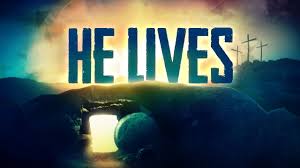
Easter is the most important holiday in the Christian calendar. It marks the resurrection of Jesus Christ from the dead, an event that transformed the world and is the foundation of our faith. The significance of Easter cannot be overemphasised, as it is a reminder of God’s love, grace, and power to overcome death.
In 1 Corinthians 15:14, the Apostle Paul states, “And if Christ has not been raised, then all our preaching is useless, and your faith is useless.” This underscores the centrality of the resurrection of Jesus Christ to the Christian faith. Without the resurrection, there would be no hope of salvation, no victory over sin and death, and no reason to believe in Jesus Christ as the Son of God.
Easter is a time for us to reflect on the sacrifice Jesus made for us on the cross and rejoice in his victory over death. As Jesus himself said in John 11:25-26, “I am the resurrection and the life. Anyone who believes in me will live, even after dying. Everyone who lives in me and believes in me will never ever die.” And therefore, we live because He lives, and because He lives, we live.
We are called to share this good news with others, as Jesus admonished his disciples in Matthew 28:19-20: “Therefore, go and make disciples of all the nations, baptizing them in the name of the Father and the Son and the Holy Spirit. Teach these new disciples to obey all the commands I have given you. And be sure of this: I am with you always, even to the end of the age.”
During the just-ended Lent, many Christians embarked on the 40-day fast as a spiritual discipline to draw closer to God. This was a time of sacrifice, prayer, and reflection, and we should commend those who committed to this practice. May all their prayers be answered in accordance with the will of God.
As we celebrate Easter, let us thank God for the sacrifice of Jesus on the cross and His victory over death. Let us also be bold in sharing the good news of the Gospel with others, knowing that Jesus is with us always. And let us encourage those who fasted during Lent to share their testimonies of God’s goodness and faithfulness in their lives. May we all experience the power of the resurrection in our lives and be transformed by the love of Christ.
Happy Easter!
Written by Kow Abaka Essuman, an advocate for Jesus Christ.
Seven Words from the Cross: The Powerful Messages of Jesus in His Final Moments
Posted on April 7, 2023 Leave a Comment

The final moments of Jesus’s life on earth were marked by immense suffering and anguish as He hung on the cross. Despite the excruciating pain, He spoke seven powerful words that continue to inspire and comfort Christians around the world. These seven words offer insight into the depth of Jesus’s love, His mission on earth, and His ultimate victory over death. In this post, I have sought to set out these seven words and explain them as best as I understand them.
- “Father, forgive them, for they do not know what they are doing.” (Luke 23:34)
The first of Jesus’s seven words on the cross is a powerful expression of forgiveness. While He hung on the cross, Jesus prayed for those who were responsible for his suffering and death, asking his Father in Heaven to forgive them. What is striking is that Jesus adds, “for they do not know what they are doing”? The soldiers knew they were killing Jesus but little did they know that they were rather giving Him the opportunity to save mankind. Jesus asked the Father to forgive them for their ignorance, and perhaps their immediate act of killing Him. This act of mercy is a powerful reminder that even in our darkest moments, we are called to show compassion and forgiveness towards others.
- “Truly I tell you, today you will be with me in paradise.” (Luke 23:43)
The second word of Jesus on the cross is a message of hope and salvation. As He hung between two criminals, Jesus assured one of them that he would be with Him in paradise that very day. This word reminds us that no matter how far we may have strayed from God, there is always the possibility of redemption and eternal life. We have to recognise that we are sinners and then believe in our hearts that Jesus is the only one who can save us from our sins and draw us closer to Him. Jesus yearns for us to be with Him in paradise however, the ball is in our court. We have to make that decision to confess Him as our Lord and saviour.
- “Woman, here is your son. . . . Here is your mother.” (John 19:26-27)
The third word of Jesus on the cross is a reminder of the importance of community and caring for one another. He entrusted His mother to the care of His beloved disciple, John, and by this act, Jesus showed His love and concern for those closest to Him, even in his final moments. We were created to serve one another and care for one another. All throughout this Lenten period, we are supposed to pray for one another and give willingly to one another.
- “My God, my God, why have you forsaken me?” (Matthew 27:46 and Mark 15:34)
The fourth word of Jesus on the cross is a cry of despair and anguish. He felt the weight of the sins of the world upon His shoulders and cried out to His Father in Heaven, questioning why He had been abandoned. The truth is God had not abandoned Jesus. God is holy and cannot be near sin. When Jesus carried all our sins upon His shoulders, it created a space between Him and the Father. But Jesus called out to His Father and His Father heard Him. This word reminds us that even in our darkest moments, we can turn to God in our pain and suffering. When sin creates a gap between our Father in Heaven and us, the devil would want us to be quiet and suffer in sin. But God wants us to recognise that He has the power to liberate us from the shackles of sin and desires for us to call out to Him. When we call out to God, and confess our sins – lay it all bare before Him – He is faithful and just, and will forgive us of our sins and cleanse us from all unrighteousness.
- “I am thirsty.” (John 19:28)
The fifth word of Jesus on the cross is a reminder of His humanity and physical suffering. As Jesus hung on the cross, He experienced thirst and dehydration, reminding us that He truly experienced the full range of human emotions and sensations. And because He was human and experienced what human beings go through, He is in a better position to intervene on our behalf before our Father. Therefore, we should not hesitate to call on Jesus because He is our advocate.
- “It is finished.” (John 19:30)
The sixth word of Jesus on the cross is a proclamation of victory and completion. With Jesus nearing the end of His earthly life, He declared that His mission on earth had been fulfilled. This word reminds us that Jesus’s death was not a defeat but a triumph over sin and death. We can rejoice in this victory.
- “Father, into your hands I commend my spirit.” (Luke 23:46)
The seventh and final word of Jesus on the cross is a statement of trust and surrender. As He breathed His last breath, Jesus entrusted His spirit to His Father in heaven, demonstrating His complete and utter faith in God. This word reminds us that no matter what trials we may face in life, we can trust in God’s love and mercy to guide us.
In conclusion, Jesus’s seven words on the cross offer a powerful testimony to His love, His mission, and His ultimate triumph over sin and death. May we always remember these words and find strength and hope in them, even in our darkest moments.
Written by Kow Abaka Essuman, an advocate for Jesus Christ.
Reflecting on Maundy Thursday: Lessons of Love and Humility from the Last Supper
Posted on April 6, 2023 Leave a Comment

Maundy Thursday, also known as Holy Thursday, is a significant day in the Christian calendar. It falls on the Thursday before Easter Sunday, and it commemorates the Last Supper of Jesus Christ with his disciples before his crucifixion.
The Last Supper is a crucial event in the Bible, recorded in the Gospel of Matthew 26:17-30, Mark 14:12-26, Luke 22:7-30, and John 13:1-26. During this meal, Jesus washed the feet of his disciples, a gesture of humility and service that has become a symbol of Christian love and charity. He also instituted the sacrament of Holy Communion, in which he shared bread and wine with his disciples, telling them that the bread represented his body, and the wine represented his blood, both of which would be given up for their salvation.
Maundy Thursday is a time for Christians to reflect on the sacrifice of Jesus Christ and the lessons that can be drawn from the Last Supper. It is a time to remember that Jesus demonstrated his love and humility by serving his disciples, and that we too should follow his example by serving others. As Jesus said in John 13:14-15, “And since I, your Lord and Teacher, have washed your feet, you ought to wash each other’s feet. I have given you an example to follow. Do as I have done to you.”
On this day, Christians are also reminded of the importance of Holy Communion, which represents the body and blood of Jesus Christ. This sacrament is a symbol of the sacrifice that Jesus made for our sins, and it is a way for us to connect with him and with each other. As Jesus said in Matthew 26:26-28, “Take, eat; this is my body. Drink of it, all of you, for this is my blood of the covenant, which is poured out for many for the forgiveness of sins.”
Maundy Thursday is a solemn and reflective day, and it is an opportunity for Christians to deepen their faith and commitment to God. It is a time to remember that Jesus came to serve, not to be served, and that we too should follow his example by serving others with love and humility. As we approach Easter Sunday, let us remember the sacrifice of Jesus Christ, and let us be inspired by his love and service to others.
In conclusion, Maundy Thursday is a significant day in the Christian calendar, marking the Last Supper of Jesus Christ with his disciples. It is a time for Christians to reflect on the sacrifice of Jesus Christ, the lessons of humility and service that can be drawn from the Last Supper, and the importance of Holy Communion as a symbol of our connection with Jesus and with each other. Let us use this day to deepen our faith and commitment to God, and to follow the example of Jesus by serving others with love and humility.
Written by Kow Abaka Essuman, an advocate for Jesus Christ.
 Official Website of Kow Essuman